Home >> Physical Stability


1. STEP®-Technology -  LUMiSizer®, LUMiFuge®, LUMiReader®, LumiCheck® 

2. Zeta Potential -  NICOMP380 ZLS

3. SPOS (single particle optical sensing) -  AccuSizer


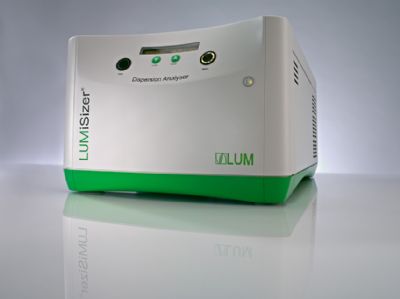
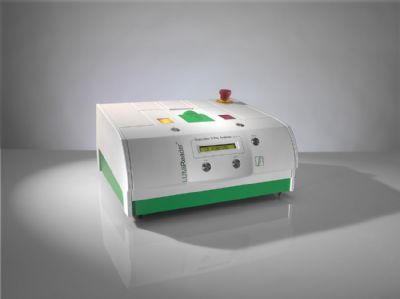
1. STEP®-Technology - LUMiFuge®, LUMiReader®, LUMiSizer®. L.U.M, Germany
 

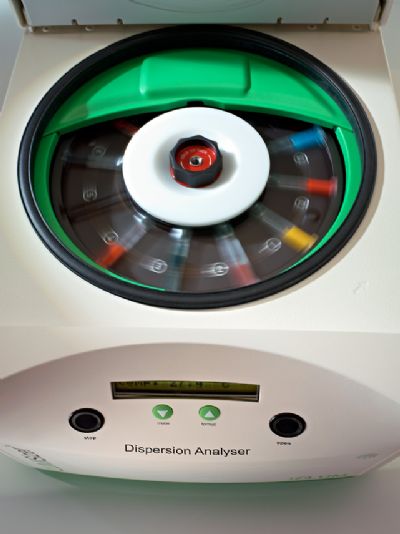
Demixing phenomena, like sedimentation, floatation or consolidation are directly measured by the LUMiReader®, LUMiFuge® or LUMiSizer® due to the patented cutting-edge STEP®-Technology.

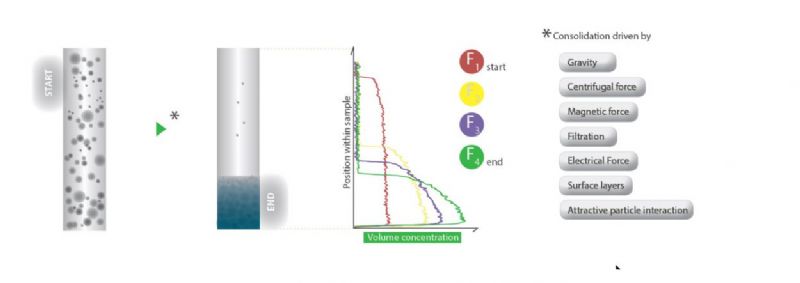
This permits to obtain Space- and Time-resolved Extinction Profiles over the entire sample length of up to 12 different samples simultaneously. Parallel near infrared (NIR) light illuminates the entire sample cell and the transmitted light is detected by the 2087 detectors of the CCD-line (pitch distance 14 µm). Transmission is converted into extinction and particle concentration may be calculated.

The unique STEP®-Technology gives high flexibility to use different cells to match specific sample properties.

By means of the comprehensive database based PC-software SEPView the light intensity can be adjusted to the corresponding sample turbidity. Transmission profiles are recorded as fast as each second or with time intervals up to hours, displayed as a sequence on the screen.

Transmission data are automatically stored in a special designed database, together with all instrument settings and actual calibration data.

The speed of the centrifuge can be set at a constant value or programmed to change during the measurement in the range from 200 rpm to 4000 rpm. These rpm-values correspond to relative centrifugal forces (RCF) at the bottom of the cell of 5 to 2300 (RCF = centrifugal acceleration/earth gravity). Built-in temperature control covers all present and future applications. 
     
    
Evaluation Features: The evolution of the transmission profiles contains the complete information on the kinetics of any concentration changes due to creaming, sedimentation, flocculation, coalescence or phase separation.

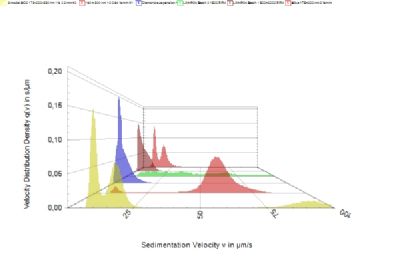
Based on these space- and time-resolved extinction profiles (STEP®-Technology) demixing phenomena are quantified regarding clarification velocity, sedimentation and flotation velocity of particles, residual turbidity, separated phase volume (liquid or solid), sediment consolidation or dewaterability.

Furthermore, comprehensive information is obtained with respect to the multimodality or polydispersity of dispersed particles.

Applications: Dispersions, emulsions, liposomes, inks, pigments, CMP slurries, cosmetics.
For the formulation, analytical and QC labs.

more info at : www.lumisizer.com ; www.lumifuge.com


2. Zeta Potential - NICOMP380 ZLS, PSS (Particle Sizing Systems) USA

The Nicomp 380/ZLS is designed to measure the electrophoretic mobility and zeta potential of charged particles in liquid suspension.

The main reason to measure zeta potential is to predict colloidal stability. The interactions between particles play an important role in colloidal stability. The use of zeta potential measurements to predict stability is an attempt to quantify these interactions.
The zeta potential is a measure of the repulsive forces between particles. And since most aqueous colloidal systems are stabilized by electrostatic repulsion, the larger the repulsive forces between particles, the less likely they will be to come close together and form an aggregate.
Thus the more stable a colloid will be.

The Nicomp 380/ZLS combines the techniques of Dynamic Light Scattering (DLS) and Electrophoretic Light Scattering (ELS) to measure both sub-micron particle size
distributions 0.001-5microns and zeta potentials in one compact instrument.

more info at : www.pssnicomp.com 
and please don't hesitate to contact us for more information to sales@tetrasense.co.il  
a demonstration is proposed at our application lab-  free of charge for the first 2 samples. 


3. SPOS (single particle optical sensing) -  AccuSizer, PSS USA

The method of single-particle optical sensing (SPOS), also called optical particle counting (OPC), was originally developed for the field of particulate contamination analysis.
Particles in gas or liquid suspension flow through a small "photozone" -- a narrow, slab-like region of uniform illumination, produced by light from a laser diode or incandescent bulb.

The particle suspension is sufficiently dilute when the particles pass, one at a time, through the illuminated region, avoiding coincidences. The passage of a particle through the sensing zone causes a detected pulse, the magnitude of which depends on the mean diameter of the particle and the physical principle of detection -- light scattering or obscuration (blockage). 


A particle size distribution (PSD) is constructed one particle at a time, by comparing the detected pulse heights with a standard calibration curve, obtained from a set of uniform particles of known diameters (standards).
The SPOS technique possesses several characteristics that make it ideal for measuring the PSD of a wide variety of particle suspensions, emulsions and dispersions. These include exceptional resolution, wide dynamic range and high sensitivity.

The AccuSizer 780 Optical Particle Sizer has refined the SPOS technique for general use in particle size analysis. Through the addition of a proprietary dilution method, called Autodilution and significant innovations in hardware and software design, this important technology is attractive for a variety of applications.
Samples of arbitrary concentration can be measured quickly and automatically, without sacrificing any of the essential advantages inherent in the SPOS method.
a demonstration is proposed at our application lab-  free of charge for the first 2 samples. 
contact us for more information to sales@tetrasense.co.il  


For more information - contact us


[Top]      [Add to Favorites]      [Site Map]      [Contact Us]
LiveCity - Website Builder